
the ontology of betweenness ‧₊˚
why 1+1 = 3


Authorial note: This experimental piece is written by two sisters, demonstrating intersubjectivity on a meta-level. It is also an ode to sisterhood; my sister—keeper of stories, guardian of shared memory, co-author of my being.
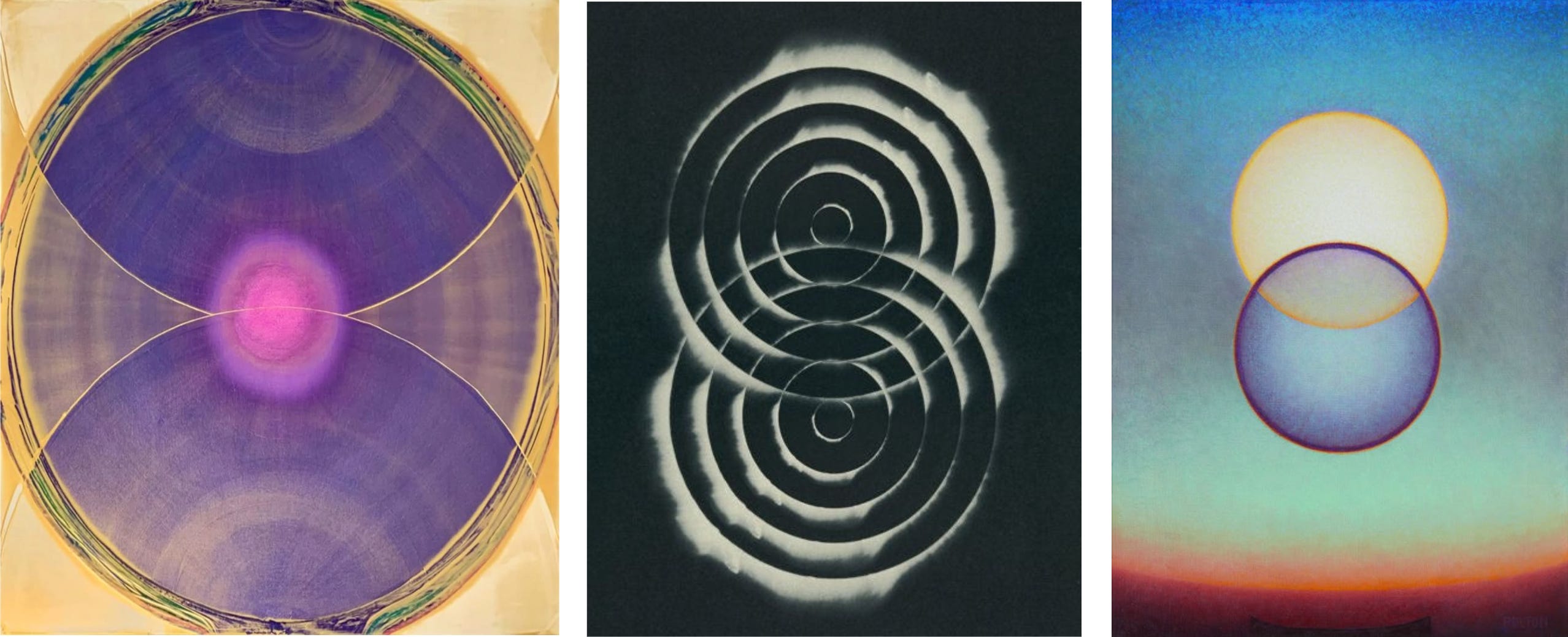
I believe if there's any kind of God it wouldn't be in any of us, not you or me but just this little space in between. If there's any kind of magic in this world it must be in the attempt of understanding someone sharing something. — Celine, Before Sunrise
Sophie: For many years now, I have been preoccupied with the concept of betweenness. What comes into being only in the space between? Perhaps this awareness stems from my position as a middle child, or a mixed, third-culture kid raised within an international community of Hong Kongers. I’m not just English nor just Chinese, but both and— something wholly new and irreducible, defying a culture that insists on clean categories. I envision colourful ink blooms melting together, as boundaries blur and identity is experienced as a dynamic, dialogic process. In a very literal sense, learning Chinese alongside English meant the spontaneous generation of Chinglish phrases and Frankensteinian grammar.
Elysia: Several layers of our identities have positioned both me and my sister Sophie as experts on liminal spaces. We were born with two names and attended two kindergartens in each of our mother tongues, learning early how to navigate the world with the fluidity required to cross thresholds. We are bridges, conduits for connection between seemingly separate realms. It’s no wonder that both of us are drawn to betweenness.
When I talk to Sophie, memories awaken across continents, from silly, decades-old sibling banter to vocabulary from our grandmother’s endangered dialect. During our calls, we bounce ideas off one another, riff on unhinged vocal tics, and go on incredible tangents. Everything somehow makes sense because we share mutual fascinations, convictions, and intuitions about how interrelated everything is. Dialogue with anyone attuned to a similar frequency is an iterative, expansive process. Like the ink blooms, I imagine our synapses reaching for each other and generating an even brighter spark.
Sophie: It’s funny you say that, because our brains really do sync up when we feel connected. When we say we are on the same wavelength, it’s more than a metaphor. Researchers call this “interbrain synchrony,” when neural activity is coordinated across brains in shared presence and attention.
Psychoanalysis echoes this meeting of minds in the idea of intersubjectivity: the third thing that emerges between analyst and patient, transforming both in the process.
This third thing is beautifully illustrated by C.S. Lewis in The Four Loves:
If, of three friends (A, B, and C), A should die, then B loses not only A but “A’s part in C,” while C loses not only A but “A’s part in B.” In each of my friends there is something that only some other friend can fully bring out. By myself, I am not large enough to call the whole man into activity; I want other lights than my own to show all his facets.
Us: Lewis points to a relational ecosystem that creates and sustains the self. The insight that we are constituted through relationship threads across disciplines, from social neuroscience to the African philosophy of Ubuntu—often translated as “I am because we are.” In our opinion, this view of personhood completely outshines Descartes’ cogito ergo sum (“I think, therefore I am”).
While we embrace the claim that the self is relational, we want to go further with the radical thesis that reality itself is relational. If subjectivity arises through participation in a relational world, then we cannot understand ourselves as detached observers standing outside of reality. Rather, we are co-creators in its ongoing unfolding. Relationships do not merely shape our experience of reality; they are the means through which reality is disclosed. Some philosophers, like Alfred Whitehead, understand reality not as static but as a continuous process of becoming. For Heidegger, aletheia describes truth as unveiling: reality continues to reveal itself through encounter.
Truth, then, cannot be divorced from experiential contact. We play unique roles in each other’s becoming, and we are constituted by the web of relationships we belong to. This is why lovers often feel they are inventing something new– because, in a sense, they are.
A common misconception about Gestalt theory is that “the whole is greater than the sum of its parts.” More accurately, the whole is different from the sum of its parts— something genuinely new emerges through their interaction. For instance, music unfolds in time, through relationship, and cannot be experienced any other way. You can’t understand a melody by analyzing one note in isolation— the meaning is between the notes, in their movement, tension, and resolution.
This relational structure is reflected not only in perception but also in language itself. All natural languages have kinship terms, reflecting how profoundly human experience is organized around relationships and social roles. In Chinese, for example, kinship terms differentiate between paternal and maternal lineage, such as yéye (爷爷) for paternal grandfather and wàigōng (外公) for maternal grandfather.
“Self-awareness” becomes a trap when the notion of the self is reduced to the illusory construct of the individual in isolation. No matter how much insight we appear to gain from solitary introspection, this must be supplemented with the fundamental awareness that the Self and Other are not discrete entities, but always in communion.
When we truly grasp that there is no Self without the Other, what follows is a profound shift towards prosociality— a deeply felt relational responsibility that extends beyond our immediate circles. For instance, many indigenous cultures emphasize gift economies, where wealth is expressed through generosity and reciprocity rather than consumption and accumulation. Similarly, we are not separate from nature. We invest in the future by planting trees and stewarding the earth, ensuring the conditions for all living beings to thrive.
Even our bodies testify to relationality. Loneliness predicts earlier mortality and cardiovascular disease, while volunteering and strong social bonds correlate with longer life and greater wellbeing. The organism flourishes in communion. In particular, sharing meals is associated with increased life satisfaction and is a protective factor against a variety of psychological disorders. The etymological origin of ‘company’ is com + panis, meaning ‘to break bread with’ in Latin.
How beautiful is it that the heart beats longer when it recognizes an Other worth beating for?
This essay is a duet. And you, dear reader, are invited to harmonize with us as it evolves into a symphony. Sophie offers neuroscience and psychoanalytic theory; Elysia grounds us in philosophy and ethics. What you’re reading is the third thing taking shape between us, a coalescence of our beings.
 | A guest post by
|
👯♀️
wow - I adore this concept and the way you've captured the magic of intersubjectivity between your own relationship! thank you for sharing.